

AI Voice Agent: The Complete Guide for 2026
Discover everything about AI voice agents in 2026: how they work, benefits, use cases, pricing, top providers, and deployment tips.


In 2026, an AI voice agent is no longer a simple technological experiment or a niche trend: it has become the central pillar of customer relations and telephone automation for thousands of businesses. Gone are the days of frustrating Interactive Voice Response (IVR) systems where the customer had to press keys on their keypad to navigate endless menus. Today, conversational voice AI allows for fluid, natural, complex conversations that are perfectly integrated with your business tools.
Why is everyone talking about AI voice agents this year? The answer is simple: the convergence of generative AI, the drastic reduction in latency (response time), and the spectacular improvement in speech synthesis has created a technology capable of matching, and even surpassing, certain basic human interactions. The AI phone assistant is revolutionizing how companies interact with their customers, manage their call flows, and qualify their leads.
The benefits for businesses are colossal. Adopting an AI receptionist makes it possible to absorb 100% of inbound calls without any wait time, drastically reduce operational costs related to level 1 support, and free up human teams so they can focus on high value-added tasks.
In this exhaustive guide, you will learn everything you need to know about AI voice agents. We will explore its exact definition, how it works technically, its quantified advantages, concrete use cases by sector, and we will give you a step-by-step method to create and deploy your own. You will also discover a comparison of the best tools on the market and how to combine this technology with human expertise through advanced platforms.
What is an AI voice agent?
To fully understand the ongoing revolution, it is crucial to define exactly what an AI voice agent is and to differentiate it from previous-generation technologies or purely textual tools.
Simple definition
An AI voice agent (sometimes called a voicebot, callbot, or conversational AI agent) is software equipped with artificial intelligence capable of conducting a telephone conversation with a human using natural language. It understands the caller's intentions, analyzes the context of the discussion in real-time, searches for information in a database or CRM, and responds with a computer-generated voice (speech synthesis) that is today almost indistinguishable from a human voice.
Difference with an Interactive Voice Response (IVR)
The traditional Interactive Voice Response (IVR) is rigid and based on static decision trees ("Press 1 for sales, press 2 for support").
- The IVR forces the user to adapt to the machine. It does not understand context and is limited to closed choices.
- The AI voice agent, on the contrary, adapts to the human. The caller can simply say: "Hello, I would like to change the time of my appointment tomorrow because something came up", and the conversational AI will understand the intention, ask for the caller's identity, check availability, and make the change.
Difference with a chatbot
Although both are conversational agents, the modality of interaction changes absolutely everything.
- The chatbot is text-based. The user has time to formulate their thoughts, read, and correct. The interface is asynchronous.
- Voice AI, however, must manage the audio stream in real-time. It must handle interruptions (when the human cuts it off), background noises, hesitations ("uh...", "hmm..."), accents, and emotions in the voice. The latency constraint is maximum: beyond 700 milliseconds of silence, the human begins to doubt the connection.
Difference with ChatGPT
ChatGPT, developed by OpenAI, is an extremely powerful large language model (LLM). However, using it raw does not make it a telephone AI voice assistant.
- ChatGPT generates long textual responses, perfect for writing or coding. If read as-is out loud, it would result in endless and unnatural monologues over the phone.
- The AI voice agent integrates a GPT-type model, but it is prompted and configured specifically for voice dialogue: it uses short sentences, asks for confirmations, gets straight to the point, and is orchestrated with complex telephony systems to handle end-to-end call automation.
How does an AI voice agent work?
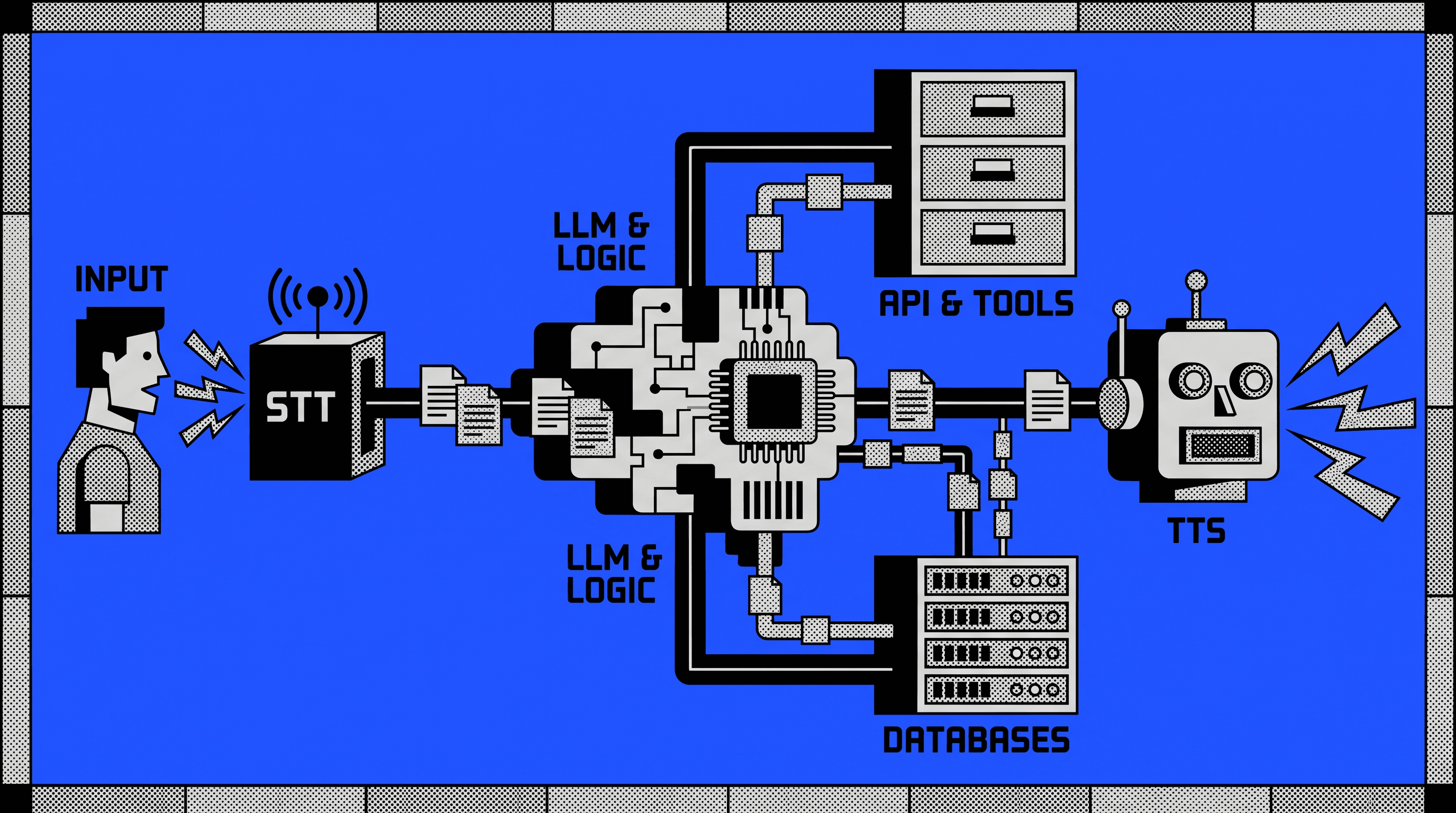
The magic of a fluid telephone conversation with a machine relies on meticulously orchestrated technical coordination between several artificial intelligence modules acting in a few hundred milliseconds.
Here is the breakdown of the classic processing chain:
Voice understanding (Speech-to-Text)
The first step is to transform the caller's speech into text. This is the role of Speech-to-Text (or ASR for Automatic Speech Recognition) models. The AI captures the audio, eliminates background noise, and transcribes the words into text with formidable accuracy, even when dealing with regional accents or a fast speaking rate.
Language understanding (LLM)
Once the text is generated, it is sent to a Large Language Model (LLM, like OpenAI's GPT-4o or Claude 3.5). This is the "brain" of the operation. The AI reads the transcription, analyzes the user's intent, and takes into account the full history of the ongoing conversation to formulate a relevant and contextual response.
Reasoning and business logic
The model doesn't just chat. It follows a "system prompt" (a set of strict instructions defining its role) and reasons. If it needs to book an appointment, it will analyze the user's request, check if it is complete (date, time, reason), and identify what is missing to ask the appropriate clarifying question.
Connection to tools (API calls)
This is where the AI voice assistant becomes a true virtual employee. Before responding, the AI can interact in real-time with your business tools (your CRM, your calendar, your inventory database) via API calls. It can thus announce: "I see that your order number 458 was shipped this morning."
Speech synthesis (Text-to-Speech)
Finally, the text generated by the "brain" must be spoken. Text-to-Speech (TTS) or speech synthesis tools come into play. They transform the text into an audio file with a natural intonation, breaths, and a human cadence. This sound is then injected into the standard telephone network straight to your customer's ear.
The major evolution of 2026: Raw audio Realtime
While the cascade model (STT > LLM > TTS) remains widely used, the year 2026 is marked by the explosion of native "Speech-to-Speech" models. Technologies like OpenAI Realtime now make it possible to bypass the conversion to text. The model directly ingests raw audio and generates raw audio as output. The benefits?
- Ultra-low latency: Response times under 300 milliseconds.
- Emotion understanding: The AI hears the tone of the voice (anger, sadness, urgency) and can adapt its own intonation accordingly, creating a stunningly empathetic conversational AI.
What are the benefits of an AI voice agent?
Integrating call automation via AI is not a technological gimmick, it is a major operational optimization and growth strategy. Here is why companies are massively replacing their old switchboards with an AI telephone reception.
Total 24/7 availability
The most obvious advantage is uninterrupted availability. An AI customer service never sleeps, doesn't take lunch breaks, and doesn't get sick. Whether your customer calls at 2 PM on a Tuesday or 3 AM on a public holiday Sunday, they will receive the same quality of reception, the same politeness, and the same efficiency.
Drastic cost reduction
Maintaining an internal or outsourced call center represents a major expense (salaries, premises, equipment, training). The per-minute cost of a voicebot is 10 to 20 times lower than that of a human operator. The return on investment (ROI) is generally seen from the first month of deployment.
Dazzling improvement in customer experience
Nothing is more frustrating for a customer than listening to hold music for 15 minutes. With an AI phone system, the absorption capacity is virtually unlimited (scalability). 100 or 10,000 customers can call at the exact same second, and the AI will pick up instantly for each of them.
Automated lead qualification
The AI does not just answer questions; it is proactive. It can ask pre-defined strategic questions to score a prospect ("What is your budget?", "How soon do you want to complete this project?"). The human sales team then only calls back warm and highly qualified leads.
Fluid appointment scheduling
By connecting directly to calendars (Google Calendar, Calendly, Doctolib, etc.), the AI voice assistant is capable of proposing time slots, managing schedule conflicts, and automatically sending confirmations via SMS or email while the call is still ongoing.
Infallible level 1 customer support
The vast majority of calls received by customer service involve repetitive requests (hours, order tracking, return policy). The thankless and tiring task is performed by the AI. Humans only intervene for complex cases (level 2 or 3) requiring negotiation, strong human empathy, or commercial exceptions.
Huge time savings and human valorization
Since redundant calls are handled solely by the AI, the time saved for existing teams is colossal. Employees can focus on creative, strategic, and high-value relational tasks, thereby improving their well-being at work by eliminating time-consuming chores.
Some key figures in 2026
- According to the latest studies, companies that have adopted conversational voice AI are seeing an average drop of 65% in call abandonment rates.
- The Average Handling Time (AHT) is reduced by 40% thanks to the automatic collection of context by the AI before any potential transfer to a human.
- More than 70% of consumers in 2026 state they prefer speaking to a high-performing AI immediately rather than waiting more than 3 minutes to speak to a human.
Use cases: Where does the AI voice agent shine the most?

The adaptability of generative AI allows this technology to be deployed in almost all business sectors. Here is a detailed list of the best current use cases, highly acclaimed by automation experts.
Real Estate: Qualification and scheduling of visits
In real estate, responsiveness is key. A prospect interested in a property often calls after seeing an ad.
The AI voice agent receives the call, asks for the buyer's criteria (budget, number of rooms, moving urgency, financing validity), and directly schedules a visit in the real estate agent's calendar if the profile matches the expectations.
Healthcare: Optimized medical secretariat
Medical practices are often overwhelmed with calls, preventing doctors or secretaries from working peacefully.
The AI receptionist (configured to comply with strict health data confidentiality - HIPAA/HDS) manages the booking, cancellation, and rescheduling of appointments, gives practical information about the clinic, and intelligently redirects vital emergencies to 911 or the on-call doctor.
Insurance: Immediate claim declaration
When a client has an accident or water damage, they are often under stress.
The AI phone assistant calmly guides them, 24/7. It asks the essential regulatory questions, opens the file in the insurance company's CRM in real-time, and advises them on the first emergency measures to take.
E-commerce: After-Sales Service and WISMO
The question "Where is my order?" (WISMO) often accounts for 50% of an e-tailer's calls.
The callbot simply asks for the order number or identifies it through the caller's phone number. It queries the carrier's API and replies: "Your package is currently at the sorting center in Orlando and will be delivered tomorrow before 1 PM". It can also handle simple return or refund requests.
Hospitality: Reservations and virtual concierge
Hoteliers lose many direct bookings when the reception is busy (especially during check-in/check-out).
The AI conversational agent takes over: it provides availability, rates, and finalizes the reservation. Once the guest is on-site, the AI can act as an internal telephone concierge (ordering room service, booking a taxi, requesting extra towels).
Professional services (Lawyers, Accountants)
For liberal professions, every minute counts.
The AI serves as a professional filter. It greets the client, identifies the reason for the legal or accounting request, ensures that the prerequisite supporting documents have been sent by email, and sets up a qualified phone appointment for the professional.
Restaurants: Reservations during the rush
During lunch or dinner service, the team is in the dining room and the phone rings unanswered.
The restaurant's AI phone system picks up, takes the reservation (number of guests, time, possible allergies), enters it into the POS or booking software (like TheFork/Zenchef), and confirms via SMS.
Recruitment: Mass pre-screening of candidates
For roles generating thousands of applications (retail, events, fast food), the AI automatically calls candidates (or receives their calls).
The voice AI conducts a 3-minute pre-screening phone interview: checking availability, diplomas, and basic prerequisites (e.g., driver's license). The recruiter only gets a shortlist of the best profiles along with the call transcript.
Teleprospecting (Cold Calling)
Although highly regulated legally (respect for Do Not Call registries, GDPR), the use of an automated call by AI for B2C cold canvassing is exploding. The AI can contact hundreds of prospects per hour in a personalized way to pitch a solution, identify the decision-maker, and qualify interest before transferring a "hot lead" to a human sales rep.
How to create an AI voice agent?
Creating an AI voice agent is no longer reserved for an elite group of Machine Learning engineers. Thanks to the no-code or low-code platforms of 2026, integration has become accessible, provided you follow a rigorous methodology.
1. Define objectives and scope
Do not try to create an omniscient AI that knows how to do everything. The failure of conversational AI projects often stems from a lack of framing. Define exactly what the agent should do: Is it purely to qualify leads? To provide customer support on a specific product? Limit the scope to ensure reliability.
2. Write the scenarios and the master prompt (System Prompt)
The system prompt is the "personality" and instruction manual of your AI. You must define in it:
- Its role: "You are Penelope, the expert AI voice assistant for Real Estate Agency X."
- Its tone: "Be professional, warm, and use short sentences."
- Its limits (Guardrails): "Never give financial advice. If asked an off-topic question, politely redirect to the purpose of the call."
- The logical flow: "First ask for the name, then the reason for the call, then collect the email address."
3. Choose your AI providers (STT, LLM, TTS models)
Select the appropriate technological building blocks. For example:
- Speech-to-Text (STT): Deepgram for exceptional latencies and ease of integration.
- LLM: GPT-4o (for its speed) or Claude 3.5 Sonnet (for conversational subtlety).
- Voice (TTS): ElevenLabs for the unmatched realism of French voices, or PlayHT.
4. Connect the CRM and business tools
An isolated AI voice assistant is useless. Use automation tools (Make, Zapier, n8n) or custom Webhooks to link the AI to your database (HubSpot, Salesforce, Notion). This is how the AI will be able to check inventory or push the call transcript into the customer file.
5. Test intensively (Stress Test)
Before launching the agent to real customers, run dozens of simulation tests. Speak quickly, interrupt it, ask absurd questions, use a heavy accent. Observe how the agent handles interruptions and the unexpected.
6. Deploy with a phone number
Purchase a VoIP phone number via providers like Twilio or Vonage, and link this number (SIP Trunking) to your AI voice agent creation platform.
7. Improve iteratively (Monitoring)
Once online, the adventure begins. You must listen to recordings of failed calls, read the transcripts, analyze where the AI "hallucinated" or got lost, and adjust your Prompt or contextual data (RAG - Retrieval-Augmented Generation) accordingly.
The best tools to create an AI voice agent
The market has structured itself around high-performing solutions. Instead of coding all the audio plumbing and complex WebSockets, you can rely on "Voice-as-a-Service" infrastructures. Here is a comparison of the leaders in 2026.
Vapi
Vapi has become one of the reference platforms for developers and automation agencies.
Strengths of Vapi
- Total flexibility: Allows you to pick and choose your STT model, LLM, and TTS vocal model a la carte.
- Interruption management: An extremely precise barge-in algorithm; the AI stops speaking instantly when the human resumes talking.
- Developer tools: Highly documented APIs, easily configurable webhooks for live actions.
Ideal for
Tech companies, AI integration agencies, and startups that want to build deep, custom-tailored solutions.
Bland AI
Bland AI positioned itself very early on massive volume, particularly for outbound calls and enterprise use.
Strengths of Bland AI
- Robust infrastructure: Designed to make tens of thousands of calls simultaneously without latency (ideal for massive campaigns).
- User-friendly interface: A very visual scenario builder that is simple to master without coding.
- Bland Turbo: Their own optimized models to reduce latency to the bare minimum.
Ideal for
Call centers, massive teleprospecting, and B2B marketing departments requiring significant striking power.
Retell AI
Retell AI is a serious competitor that has focused all its research and development on the naturalness of conversation.
Strengths of Retell AI
- Conversational dynamics: This is the tool that best handles "hmms", light laughs, and breathing pauses, making the exchange very organic.
- Native integrations: Direct and easy connection with major enterprise telephony software and leading CRMs.
- Powerful analytics: Detailed dashboards on user sentiment, average call duration, and keywords used.
Ideal for
High-end customer support, virtual concierges, and sectors (like healthcare or hospitality) where perceived empathy is paramount.
OpenAI Realtime
This is not a finished orchestration platform, but the raw infrastructure provided by the creators of ChatGPT.
Strengths of OpenAI Realtime
- Unbeatable native latency: It is a pure "Speech-to-Speech" model. There is no longer any intermediate text translation, making latency virtually invisible.
- Emotional modulation: The AI natively understands whether you are whispering or yelling, and can dynamically adapt its voice.
- Cost at scale: Potentially cheaper for those with the capability to develop the entire network architecture around the raw API.
Ideal for
Experienced engineers, companies wishing to create their own AI voice agent SaaS product, and applications requiring absolute real-time interaction.
How much does an AI voice agent cost?
Understanding the cost of a callbot requires breaking down the technical value chain. Unlike a human call center where a fixed hourly wage is paid, AI generally operates on a usage basis (Pay-As-You-Go).
The pricing model (Variable costs)
Here are the elements that make up the bill for each call:
- Telephony (e.g., Twilio): Renting the number costs about $1 to $2 per month. Routing the call minute generally costs between $0.01 and $0.02 / minute.
- Software intelligence (AI Providers): Transcription (STT), thinking (LLM like GPT-4), and voice (TTS like ElevenLabs) models charge by the "token" or character.
- The orchestration platform (e.g., Vapi, Retell): These platforms take a margin on top for their assembly service, often charging around $0.05 to $0.10 per minute.
Examples of average costs in 2026
On average, the full use of a highly performant AI voice agent will cost you between $0.10 and $0.15 per minute of call.
- For a small tradesperson or local business: With 20 calls a day lasting an average of 2 minutes (about 800 minutes per month), the variable cost will be roughly $100 to $120 per month.
- For a medium e-commerce site: With 200 daily calls of 3 minutes (about 12,000 minutes per month), the cost will be around $1,500 per month.
Added to this is often a fixed setup cost if you go through an AI integration agency, which ranges from $1,500 to $10,000 depending on the complexity of API connections (CRM, ERP) and the required security (private hosting, backups). In any case, compared to the tens of thousands of dollars required for the human equivalent, the economic calculation is quickly validated.
AI voice agent vs Human call center

Should everything be replaced? To properly contextualize the value of the voicebot, here is a point-by-point comparison between human and machine.
Capabilities of the Human switchboard
- Availability: Limited to office hours (e.g., 9 AM - 6 PM). Overtime, night shifts, and weekends are extremely expensive.
- Price: High. It includes the fully-loaded salary, equipment, management, continuous training, and physical workspace.
- Response time: Variable. Excellent during off-peak hours, but often catastrophic (wait times of several minutes) during call spikes.
- Scalability: Very low. If there is a crisis (bad buzz, server outage) generating 1,000 simultaneous calls, a human team of 10 people physically won't be able to cope.
- Quality: Unmatched for genuine empathy, complex negotiation, understanding subtle cultural undertones, and out-of-the-box conflict resolution.
Capabilities of the AI Agent
- Availability: Absolute. 24 hours a day, 7 days a week, 365 days a year, with no mood swings.
- Price: Very low and entirely variable. You only pay for the minutes actually consumed. No payroll taxes or paid leave.
- Response time: Immediate. Picking up is done on the first ring (or as configured). The cognitive response time is under 500 milliseconds.
- Scalability: Infinite. Whether you receive 1 call or 100,000 calls in the same second, processing capacity via cloud servers is immediate.
- Quality: Perfect for process tracking, information gathering, strict application of company rules, and rapid querying of databases with millions of rows. Weak on deep empathy or delicate human situations (e.g., psychological support).
The limits of voice artificial intelligence
To ensure the credibility of any tech project (Google's E-E-A-T concept - Experience, Expertise, Authoritativeness, and Trustworthiness), it is fundamental to face reality. The AI voice assistant is not perfect and in 2026 still has certain limits that must be mastered.
The risk of hallucination
Generative AI is programmed to please and respond. Sometimes, if it does not know the answer, it can invent it very convincingly (a hallucination). An AI agent that invents a 50% promo code or gives a wrong address can cost a brand dearly. You must use strict techniques (advanced RAG and restrictive Prompt Engineering) to force the AI to say "I don't know, I am transferring you" rather than making things up.
Handling extreme noise and cutouts
If the customer calls from a construction site with jackhammer noises, or from a car with the radio blasting and poor network coverage (4G/5G cutouts), the Speech-to-Text model may mishear keywords, leading to misunderstandings in the conversation.
Complex accents and dialects
Although models like OpenAI's Whisper are excellent, very pronounced accents, the use of very specific local slang, or mixing two languages in the same sentence can still cause confusion, making the exchange less fluid.
Regulation and GDPR
In Europe, recording, transcribing, and analyzing a user's voice by an AI requires strict supervision (GDPR). You must clearly inform the caller that they are interacting with artificial intelligence, collect their consent if personal or sensitive data (health, finance) is processed, and ensure that data hosting respects European sovereignty.
Emotionally sensitive calls
There are clear ethical limits. An AI receptionist should never announce a serious medical diagnosis, handle calls related to extreme psychological distress, or conduct layoffs. AI must remain an operational, commercial, and logistical support tool.
How to choose your AI voice agent?
Are you convinced of the need to take the plunge? Here is the ultimate checklist of criteria to validate before choosing your service provider or technology platform.
- Excellence in English: Most modern AI voice platforms deliver excellent English conversations since today's leading AI models are primarily trained on English data. Focus instead on evaluating voice naturalness, pronunciation accuracy, accent options, and industry-specific terminology to ensure the best customer experience.
- Natural and modular voice: Verify that you can choose between different voices (male, female, young, mature) to match your company's branding.
- Conversational granularity: Does the system allow you to adjust the wait time before responding? Does it handle interruptions well without crashing the LLM's logic?
- External Tools & CRM Integration: The tool must offer REST APIs, Webhooks, or native integrations with HubSpot, Salesforce, Zendesk, or Shopify.
- Phone numbers (VoIP): Is it easy to port (portability) your existing business number to the AI via VoIP?
- Security and Hosting: Demand transparency on server locations and non-training clauses for models on your proprietary data.
- Business customization: Can you easily inject your company's knowledge base (PDF documents, website) so that the AI knows your products inside out?
- Dashboard: The tool must provide you with full transcripts, audio recording, and an automatically generated summary of each call.
How to combine an AI receptionist and human reception?
The winning strategy in 2026 is neither "100% AI" nor "100% Human". Ultimate performance lies in the synergy of both, which is called the hybrid platform model. The goal is to create an intelligent telephone funnel.
1. The AI answers all inbound calls (The shield)
In this configuration, your main business number is directly routed to the AI phone system. This guarantees an immediate response, with no ringing in a void, available 24/7. The brand projects an image of total availability.
2. The AI filters first-level requests
From the first seconds, the voice agent questions the caller. If the request concerns basic information (opening hours, delivery address, return policy) or a simple automatable action (booking an appointment in the calendar, canceling a recent order), the AI handles the request end-to-end. The human is never disturbed for this.
3. Strategic calls are automatically transferred
If the AI identifies a situation requiring human expertise or a major commercial opportunity, it triggers a conditional call transfer.
- Ultra-qualified prospect: "Would you like a $50,000 quote? Please hold, I am transferring you to our sales director."
- VIP Client: Number recognition, priority transfer.
- Urgent or complex complaint: The AI senses frustration in the voice (sentiment analysis) and hands over to the customer support manager.
4. The employee takes over the call with all the context (The sword)
This is the major revolution! When a platform transfers the call to your human employee, it does not just ring the phone. It instantly pushes to the employee's computer screen (via the CRM) a text summary of the previous 3 minutes of conversation, generated by the AI in real-time, along with the collected data (customer name, exact reason). No more making the customer repeat themselves; the time saved and the impact on the customer experience are staggering.
5. A hybrid platform like GlideCx.AI
To orchestrate this complex dance between human and machine, emerging and highly mature platforms, like GlideCx.AI, will establish themselves on the market. These centralized systems allow you to visually define custom transfer rules (routing by department, time of day, or urgency), listen to an AI-managed call live, and take manual control at any time with a single click if the human operator feels it is necessary. The entire history and transcription remain saved in the management interface.
6. The ultimate benefits for the company
This hybrid model generates a virtuous circle:
- No more lost calls: No more missed commercial opportunities.
- More appointments and sales: The qualification funnel operates continuously.
- Fewer interruptions for the teams: The production team's phone no longer rings untimely for trivialities.
- Better customer satisfaction: The customer gets an immediate response and a human expert only intervenes where they add real value. It is the perfect balance between call automation and the warmth of human relations.
Conclusion
Integrating an AI voice agent in 2026 is no longer an option for companies that want to remain competitive, scalable, and offer a flawless customer experience. By transforming the heavy burden of telephone management into a fluid, intelligent, and automated process, conversational AI drastically reduces costs, optimizes lead qualification, and relieves human teams of repetitive and thankless tasks.
From the local tradesperson overwhelmed with calls to the large multinational e-commerce company looking to scale its global customer support, the technology is today mature, affordable, and secure. The key to success lies in properly configuring business tools and adopting a hybrid model where the AI phone assistant serves as an infallible front line before passing the baton to human expertise.
Ready to bring your customer relations into the new era? Nothing beats a demonstration to measure the potential of an AI voice agent. Compare the different solutions on the market, evaluate the quality of their conversations, and test for yourself their ability to automate your calls while providing a natural experience. In just a few minutes, you can create your first voice agent and discover how AI can transform your company's telephone reception.
Frequently Asked Questions
An AI voice agent is artificial intelligence software designed to hold fluid telephone conversations with humans, in real-time. It listens (Speech-to-Text), understands intent (LLM), reasons, and responds with a computer-generated voice (Text-to-Speech) in a very natural way.
ChatGPT is a general text interface designed for writing and analysis. An AI voice agent uses a similar model for its "brain," but it is specifically formatted for the audio format (short sentences, handling interruptions, telephony connectivity) with extreme latency constraints (under 500 ms).
Pricing is generally per minute of use (Pay-As-You-Go). Including telephony fees, AI tokens, and the orchestration platform's margin, it costs between $0.10 and $0.15 per minute. Setup fees may apply if you use an agency.
Yes, it is even fundamental. The AI voice agent can be connected via API or Webhooks to CRMs like HubSpot, Salesforce, or Zoho. This allows it to read a customer's history in real-time, push the call transcript into the customer file, or update the status of a support ticket.
Absolutely. An AI voice agent can be synchronized with tools like Calendly, Google Calendar, or Doctolib. It cross-references your calendar's availability with the customer's request, schedules the appointment, blocks the time slot, and can trigger a confirmation SMS.
Yes, it is perfectly legal, but subject to regulation. You must particularly respect data privacy laws, and it is highly recommended to inform the caller at the start of the conversation that they are interacting with artificial intelligence to comply with the transparency principle of new AI laws (like the European AI Act).
Yes, provided your tools are configured correctly. You must ensure that the AI model provider (such as OpenAI, Anthropic, or an Open Source model hosted locally) does not use your customers' data to train its own public models, and obtain consent if you process highly personal data (health, banking data).
If you are looking to develop a highly modular solution, Vapi is the current reference. For massive outbound calls, Bland AI is very powerful. Finally, if you want to orchestrate a sophisticated end-to-end hybrid human/AI management system, a platform like GlideCx.AI will be the most relevant.